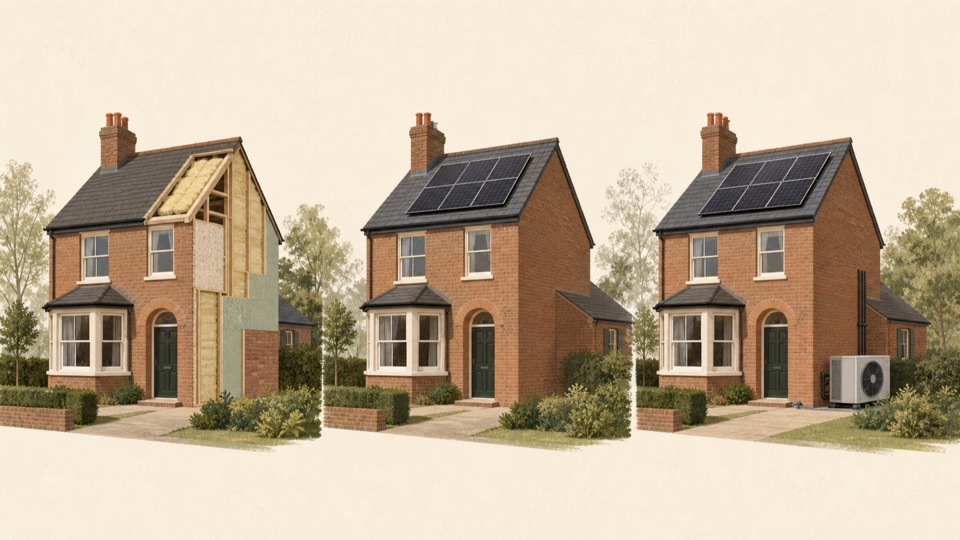
Which route deserves attention first?
Use the home’s constraint and trigger event—not a product preference—to choose the next assessment.
This prioritises further assessment; it does not declare a technology suitable or calculate returns.
Solar panels vs heat pumps vs insulation: which comes first?
| Factor | Insulation first | Solar first | Heat pump first |
|---|---|---|---|
| Strongest signal | Cold surfaces, obvious heat loss, accessible opportunity | Sound unshaded roof, good electricity use profile | Heating replacement is urgent or planned |
| Main benefit | Comfort and lower heat demand | Lower imported electricity and export income | Low-carbon heating and system renewal |
| Design dependency | Moisture and ventilation assessment | Roof survey and generation model | Room-by-room heat loss and emitter design |
| Reason to wait | Active damp or unsuitable construction detail | Roof replacement due soon | No credible system design or electrical plan |
| What it prepares | Potentially smaller heating system | Future electric demand | A route away from fossil heating |
When is insulation the best first investment?
Put insulation first when the building has a clear, suitable and well-understood heat-loss opportunity—especially an accessible loft—or when comfort is the main problem. It can reduce heating demand and may allow a smaller heating system later. But “insulate everything” is not a safe specification: construction, damp, thermal bridges and ventilation matter.
When is solar the best first investment?
Solar can move ahead of fabric work when the roof is sound, shade is acceptable and the household can use or sensibly export the generation. It does not need to wait for a heat pump. If a roof replacement, electrical upgrade or scaffolded project is already planned, coordinating the work may improve the case.
When should heat-pump planning come first?
If the existing heating is failing, start design immediately. Older or imperfectly insulated homes are not automatically excluded: the important questions are heat loss, required flow temperature, emitter capacity, hot water and electrical provision. Practical insulation can be designed alongside the system rather than used as an indefinite reason to delay.
A survey is not the same as a design
Before accepting a quote, ask for the room-by-room heat-loss calculation and see how it connects to heat-pump output, design flow temperature and each room’s emitter.
Five questions that settle the order
- Is anything unsafe, wet or failing? Resolve that constraint first.
- Is a roof, room or heating system already being replaced? Use the trigger event to avoid duplicated work.
- Is comfort or electricity cost the bigger problem? That separates fabric from generation.
- Will this choice change the size or access needs of a later project? Coordinate before committing.
- Can the supplier show home-specific assumptions? If not, the comparison is not ready.