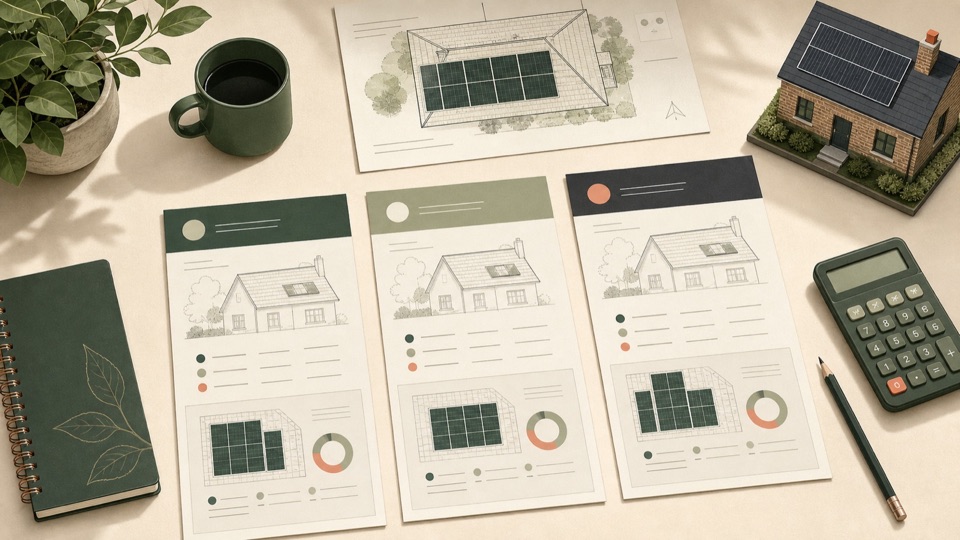
What should a solar panel quote include?
Your checks are saved only in this browser. Tick an item only when it appears in writing.
-
01
A roof-specific layout
Panel positions, roof faces, orientation, pitch, obstructions, access and shading should match your home.
-
02
Panel count, wattage and array size
Record the exact panel and inverter models, total kWp and any export limitation.
-
03
Annual generation in kWh
Ask for the method, location and shading assumptions—not only a percentage bill reduction.
-
04
Self-consumption and export shown separately
The value of electricity used at home differs from exported electricity. Both volumes and rates should be visible.
-
05
A solar-only financial case
See the panels without a battery first, including degradation, tariff assumptions and whether maintenance or replacement is modeled.
-
06
A separate battery case
Record usable—not merely nominal—capacity, power, round-trip losses, warranty, cycles and the operating strategy.
-
07
Roof, mounting and access scope
Scaffolding, structural checks, roof repairs, bird protection, cable routes and making good must be included or excluded.
-
08
Electrical and grid scope
Consumer-unit work, earthing, meters, isolators, DNO notification/application and export controls should be clear.
-
09
Certification and protection
Check the installer, products, consumer-code route, deposit/payment protection and cancellation terms.
-
10
Commissioning and handover
Expect testing, monitoring access, system explanation, MCS certificate, warranties, manuals and fault contacts.
Put every solar quote into the same comparison
| Record | Quote A | Quote B | Quote C |
|---|---|---|---|
| Array size / annual generation | ___ kWp / ___ kWh | ___ kWp / ___ kWh | ___ kWp / ___ kWh |
| Self-use / export | ___% / ___% | ___% / ___% | ___% / ___% |
| Import / export rate assumed | ___p / ___p | ___p / ___p | ___p / ___p |
| Battery usable capacity | ___ kWh | ___ kWh | ___ kWh |
| Scaffold and electrical work | Included? | Included? | Included? |
| Total installed price | £___ | £___ | £___ |
How do you decide whether the battery is worth adding?
Compare panels alone with panels plus storage using the same generation and tariff assumptions. A battery can increase solar self-use and interact with a time-of-use tariff, but it adds cost, conversion losses and a shorter component life than many panels. The proposal should explain how often and why it cycles.
What are the solar quote red flags?
- A generic generation figure that does not show roof orientation or shading.
- One “annual saving” that hides self-use, export volumes and unit rates.
- Battery capacity is quoted without saying whether it is usable or nominal.
- Scaffolding, roof work, electrical upgrades or grid requirements are left vague.
- Payback is presented as guaranteed while tariffs and behaviour are assumed.
- You are pressured to sign quickly or discouraged from comparing certified installers.